Dev Career Orbits: Navigating Your Path in Software Development
Overhearing a conversation with Code Complete author Steve McConnell and Gergely Orosz on the podcast Pragmatic Engineer, I was reminded of the missing mindset of developer career paths, except for those designed by HR departments which are mostly generic in nature and never really tailored to software developers or related technical roles. Steve described how developers often get stuck in a “code monkey” role or struggle as managers, unable to break free and advance their careers. This resonated with me, as I’ve seen many talented developers struggle to find their way in the industry.
To address this, I propose the concept of “Dev Career Orbits,” a framework that outlines various career dimensions for developers, from individual contributors to leadership roles. This framework can help developers visualize their career paths and identify opportunities for growth and advancement. Just a hint: as with any model, this is a simplification of reality - there’re always exceptions to the rules.
The Dev Career Orbits Framework
The areas, where you focus to grow skills and contribute in, I call areas of “probability density”. Like electrons, your skills are not represented by a single point, but a cloud of changing and various density. Steve proposed four areas: business, technology, people and best practices. I’m replacing the ladder with the more often used “process” - which includes best practices and cross-cutting concerns like security.
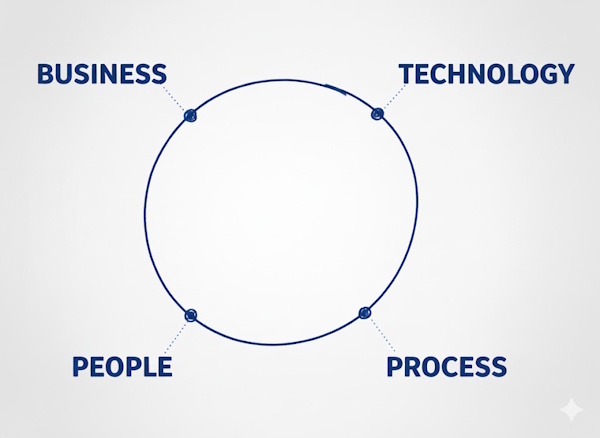
In this model, your career path is represented by orbits around a central point, which represents your core skills and expertise. The closer you are to the center, the more generalist you are, while the further out you orbit, the more specialized you become in a particular area or rather between two adjacent areas.
Attributes of the Areas
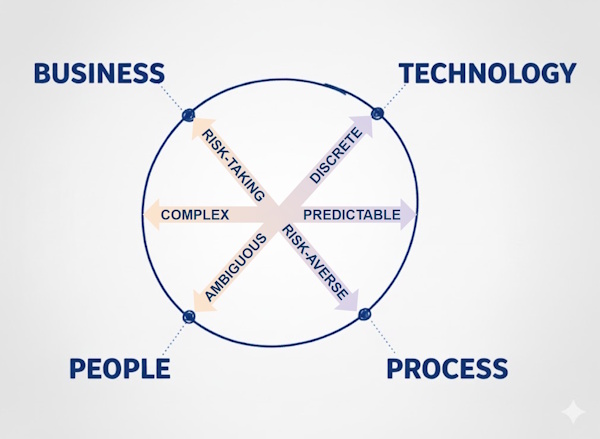
Additionally, you should consider the attributes of each area which can be seen as the ends of a spectrum. For instance technology is discrete, while people are ambiguous. Business has to take risks while process is about minimizing risks. Business and people are hence more complex, while technology and process are more predictable. Understanding these attributes can help you navigate your career path more effectively.
Navigating Your Career Path
For your career advancement, you should also consider, which environment you’re working in. Are you working at a startup, a scale-up company, or an established corporation? Each environment has its own set of challenges and opportunities for growth.
Let’s consider a startup environment. In a startup, you may have the opportunity to wear multiple hats and take on a variety of roles. This can be a great way to gain experience and develop new skills, but it can also be overwhelming if continued for too long without focus. To succeed in a startup, you need to be adaptable, willing to learn, and able to work well under pressure. In our orbit model, this is where you can grow your skills in all four areas: business, technology, people, and process - but you won’t have much guidance and need to figure out a lot on your own. You orbit close to the center of the model, i.e. you need to be a generalist.
Later in your career, you may find yourself in a scale-up company. As the company matures, you may have the opportunity to specialize in a particular area, such as technology or business. You may also have the chance to take on leadership roles and mentor junior developers. To succeed, you may have to draw boundaries around your work and focus on a specific area of expertise. In our orbit model, you may start to orbit further out from the center, focusing on one or two areas while still maintaining some generalist skills.
Finally, in an established corporation, you may have the opportunity to work on large-scale projects and collaborate with cross-functional teams. You may also have access to more resources and support for professional development. To succeed in this environment, you need to be able to navigate complex organizational structures and work effectively with stakeholders at all levels. In our orbit model, you may find yourself orbiting even further out, focusing on a specific area of expertise while still maintaining a broad understanding of the business and technology landscape.
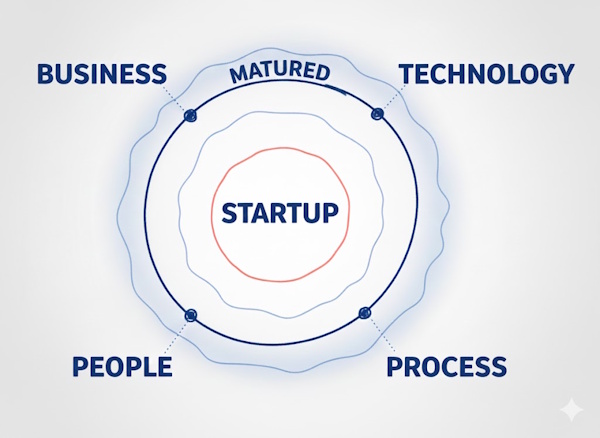
Now try to spot your position in the model and where you want to go next. Following, are some example orbits.
Examples
TechDebt Specialist: Orbits between Technology and Process, focusing on identifying and mitigating technical debt within software systems. It conflicts with Business as reducing tech debt often requires upfront investment without immediate business value.
Manager: Orbits between People and Business, leading teams to achieve business objectives. It conflicts with Technology as managers may prioritize business goals over technical excellence. It may however, cause a previously techonical individual contributor to move closer to the center of the model, becoming more of a generalist or dismiss the management position to return into a individual contributor role.
Architect: Orbits between Technology and Business, designing systems that align with business goals. It may conflict with Process as architects may prioritize innovation over established best practices.
Quality Advocate: Orbits between Process and People, promoting quality practices within development teams. It may conflict with Technology as quality advocates may push for rigorous testing and documentation that developers see as slowing down technical innovation.
Conclusion
The Dev Career Orbits framework provides a useful way to visualize and navigate your career path as a software developer. By understanding the different areas of expertise and the attributes of each area, you can identify opportunities for growth and advancement in your career. Whether you’re working in a startup, scale-up, or established corporation, the key to success is to be adaptable, willing to learn, and able to work effectively with others. By embracing the Dev Career Orbits framework, you can take control of your career and achieve your professional goals.