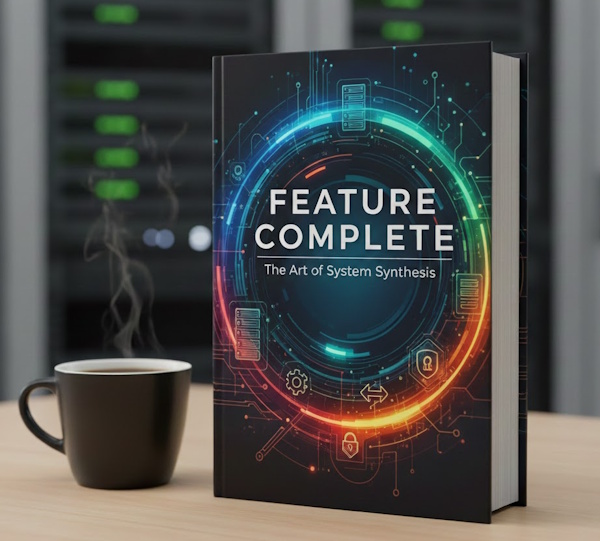
Feature Complete: The Art of System Synthesis
The hypothetical book Feature Complete serves as the manual for the “Deployment Pipeline”—the path that turns a “Code Complete” artifact into a “Feature Complete” service as part of a larger, integrated system - the system synthesis. If you like the idea or want to give feedback, please reach out to me on Twitter via email at book-feature-complete[at]geekslist.net. Tell me, what you miss or what you like about the idea.
Introduction: Beyond the Construction Site
In his seminal work Code Complete, Steve McConnell defined “Construction” as the heart of software development. He provided the industry with a definitive guide to the craftsmanship of building robust, high-quality components. However, in the decades since, the landscape of software has shifted. The primary challenge is no longer just how we build the “bricks” of our applications, but how we cement them into an increasingly complex, interconnected, and hostile global infrastructure.
If Code Complete ends when the last line of logic is written, Feature Complete begins at the moment that code attempts to live in the real world.
The Evolution of “Complete”
The title Feature Complete draws on the milestone that follows construction. While “Code Complete” signifies that the typing is finished, a feature is not truly “complete” until it is synthesized. In modern software engineering, a feature only exists once it has survived the “Integrated Gauntlet”: it must communicate seamlessly with external APIs, pass rigorous automated security scans, and function reliably across distributed environments.
This book serves as the successor to McConnell’s philosophy, moving the focus from the Routine to the Relationship. We move from the internal quality of a class to the external integrity of a system.
The Core Pillars
Feature Complete provides a systematic engineering approach to the “last mile” of development, organized into four critical dimensions:
Systemic Integration: Moving beyond unit tests to validate the “contracts” between services. We explore how to build resilient interfaces that handle the failures of adjacent systems gracefully.
The Security Hardening Lifecycle: Shifting security “left” by integrating vulnerability scanning, dependency analysis, and threat modeling into the immediate aftermath of construction.
Deployment as Verification: Treating the deployment pipeline as the final arbiter of quality. We discuss how “complete” is a state achieved only through successful orchestration and environmental parity.
Operational Observability: Defining completion not just by functional correctness, but by the ability to monitor, trace, and debug the feature in a live, integrated production state.
Bridging the Gap
While Code Complete taught us how to write code that works, Feature Complete teaches us how to build software that belongs. It is a guide for the modern developer who recognizes that in a world of microservices, cloud-native architectures, and continuous delivery, the individual component is only as strong as its connection to the whole.
Table of Contents
Part I: The Foundation of Delivery
Ch 1: The Definition of Done: Redefines “Done” to include integration and deployment. It argues that code is an asset only when it is in production and a liability until then.
Ch 2: The Deployment Pipeline: Introduces the concept of the automated path to production. It explains how to structure the stages of a pipeline to provide fast feedback to the developer.
Ch 3: Configuration Management: Covers the necessity of versioning everything—not just code, but environment configurations, build scripts, and database schemas.
Part II: Validating the Integrated System
Ch 4: Automated Acceptance Testing: Moves beyond unit tests to verify that the software meets the “Acceptance Criteria” of a feature. It focuses on testing the system from the user’s perspective.
Ch 5: Managing the Data Lifecycle: One of the hardest parts of integration. This chapter details strategies for database migrations, automated schema updates, and maintaining data integrity during deployments.
Ch 6: Component and Contract Testing: Teaches how to test individual services in isolation while ensuring they still honor their “contracts” with the rest of the ecosystem.
Part III: Hardening and Security
Ch 7: Continuous Security Scanning: How to integrate automated vulnerability assessments (SAST/DAST) into the pipeline. It treats security flaws with the same urgency as syntax errors.
Ch 8: Compliance and Audit as Code: Discusses how to automate the “paperwork” of software delivery. It explains how a well-structured pipeline acts as an immutable audit trail for regulatory requirements.
Part IV: Deployment Strategies and Release Patterns
Ch 9: Decoupling Deployment from Release: Explores how to push code to production without “releasing” it to users. It covers technical patterns like Feature Toggles and Dark Launching.
Ch 10: Low-Risk Release Patterns: Detailed guides on Blue-Green deployments and Canary releases. It focuses on how to swap versions of a system with zero downtime.
Ch 11: The “If it Hurts, Do it More Often” Philosophy: A deep dive into why frequent, small releases are safer than infrequent, large ones. It provides a roadmap for moving from monthly releases to multiple deployments per day.
Part V: Resilience and Stability
Ch 12: Designing for Failure (Resilience): Moving from “Correctness” to “Robustness.” It introduces architectural patterns like timeouts, retries, and circuit breakers to prevent systemic collapse when an integrated system fails.
Ch 13: Observability and Feedback Loops: Defines the telemetry needed to prove a feature is working. It covers the “Three Pillars”: Metrics, Logging, and Distributed Tracing.
Part VI: The Human Side of the System
Ch 14: Culture and Collaboration: Discusses the breakdown of silos between development and other departments. It emphasizes shared responsibility for the successful delivery of a feature.
Ch 15: Continuous Improvement of the Process: How to use post-mortems and value-stream mapping to find bottlenecks in your delivery pipeline and fix them.
Synthesis: The “Feature Complete” Summary
While Code Complete taught us how to build a high-quality engine, Feature Complete is about building the entire vehicle, the road, and the navigation system.
The book’s central thesis is that Software Construction is not an end in itself; it is a means to a delivered service. By the time you reach the final chapter, you will have moved from a “Programmer” to a “Systems Engineer” capable of delivering secure, integrated, and resilient features.